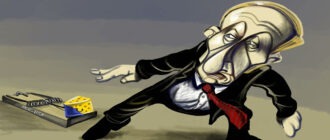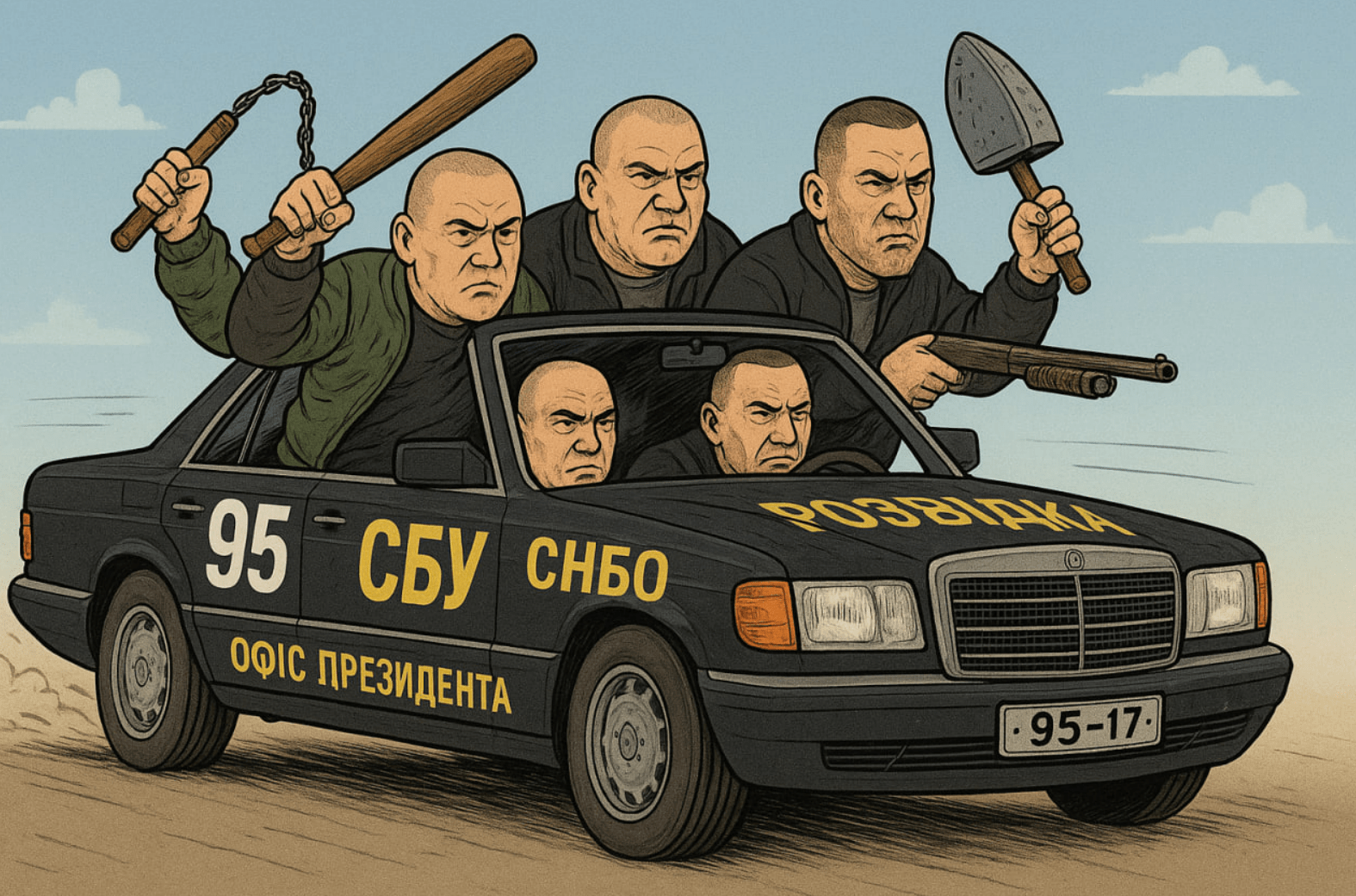
If I ever had the chance to interview Volodymyr Zelensky, I’d open with a blunt question: in your early creative years, did you or did you not engage in racketeering? After a pause — after the inevitable flicker of confusion — the question could be widened.
Picture a mid-level public figure: a provincial mayor, a forgettable MP (in either parliament — Mr. Zelensky spent years performing for both — Ukraine and Russia), a deputy governor, a district official. Someone visible, but harmless. The perfect target for a cocky cultural hustler from the capital.
Then you read in the paper that this person has stumbled into something unsavory: an ex-wife’s accusation after a messy divorce, whispers of bribery, or simply a burst sewage pipe in the infrastructure he oversees. Something murky, messy — not criminal, but embarrassing. The kind of thing you want the public to forget fast. And above all, he wants them to forget — for the sake of his career.
So you shoot a sketch, put it on video, and then offer the man the chance to buy the rights. If he refuses? The merry boys of Kvartal will drag him through the mud on national television. For years, if needed. If he pays — he disappears from the script. I suspect this has long been a meaningful revenue stream for any stand-up collective.
Zelensky could dodge or deny, admit or moralize. It doesn’t matter. The point isn’t Kvartal 95. It’s the governing philosophy. Every leader builds the state in the style he knows. Kravchuk built a talk show. Kuchma — a factory. Yushchenko — a secretive credit machine that shoved citizens into debt. Yanukovych — a car depot. Poroshenko — a TV studio and a toxic candy empire. Zelensky built a protection racket.
And under Zelensky, racketeering is not street-corner thuggery. It’s an institution — a system running through every artery of the state. Donate, and you’ll be fine is its core law. Donate well enough, and you can sell cocaine or carve soldiers up for organs in hospital basements. They’ll even slap flashing lights onto your cars.
Want to leave the country? It’ll cost you roughly the price of a cheap apartment in Troieshchyna. Getting away from enlistment officers on the street is cheaper, but endlessly repeatable. If you have cash on hand, you can get off for a thousand. Sometimes a few hundred. Get dragged into the bus — the fee goes up. Reach the enlistment office — up again.
A medical board exemption costs even more. More participants, more “interests,” more bosses — and each boss must be paid. And he pays his boss. And that one pays another. Ever higher and higher.
Leaked NABU tapes suggest that National Security and Defense Council Secretary Danilov was slapping sanctions on businesses — and then quietly removing them — for a cool half-million. Week after week, he reportedly shook down hundreds. And Verkhovna Rada MP Anna Skorokhod? If the SBU and NABU footage is legit, she was running her own side hustle: putting competitors on the sanctions list for just a hundred thousand a head. Getting your name taken off that list through Danilov cost five times more.
At the front, commanders charge for everything: a transfer to a cushier unit (you can die defending Myrnohrad, or you can guard the Moldovan border), for leave, for a cook’s job, for a place in the warehouse, for skipping combat missions, even for slipping into the stabilization zone.
And the money flows upward.
SBU officers emptying a detainee’s bank cards — carry it upward. Detention center guards selling VIP cells with restaurant meals and call-in prostitutes — upward. Charging diabetics for insulin delivery — upward. And all those streams converge at the very top. Not because the top wants it. Because the system demands it.
Until recently, Andriy Yermak was the “top,” and the machine worked flawlessly. Now he’s gone — and the edifice is shaking. Every local “top” now thinks he owes nothing to the “very top.” Bring the money to Zelensky? He’d be afraid to take it.
And when there’s nowhere to pay up, there’s no arbiter. No one to settle disputes. Every mid-tier boss declares himself the supreme boss. And they begin ripping each other apart.
This turf war has now reached the country’s sanctum — Koncha-Zaspa, where among Ukraine’s most elite real estate an actual firefight broke out between GUR and Defense Ministry personnel. The prize: a sanatorium.
This isn’t some knife brawl between the Cardinal’s guards and the King’s musketeers in a dark corner of the Bois de Boulogne. This is a mass brawl nearly inside the Louvre — endangering the palace’s own residents.
I won’t predict the ending. I’ll just note this: a total extortion system that loses its final point of control becomes more dangerous to its creator than the Russian army or Washington’s impatience. You can negotiate with those. You can run from those.
But when the protection racket collapses, and the gang war starts at the top — there’s nowhere left to run. Ukrainians were so terrified of the old ‘gangster rule’ returning through the Party of Regions and Russian oligarchs muscling in on businesses that they didn’t even notice when the shakedown came wrapped in the banner of ‘fighting Russian aggression.’ Now you don’t pay for protection — you pay for the privilege of simply being allowed to live.