The Marshal’s Surrender and the Castration of the Tandem
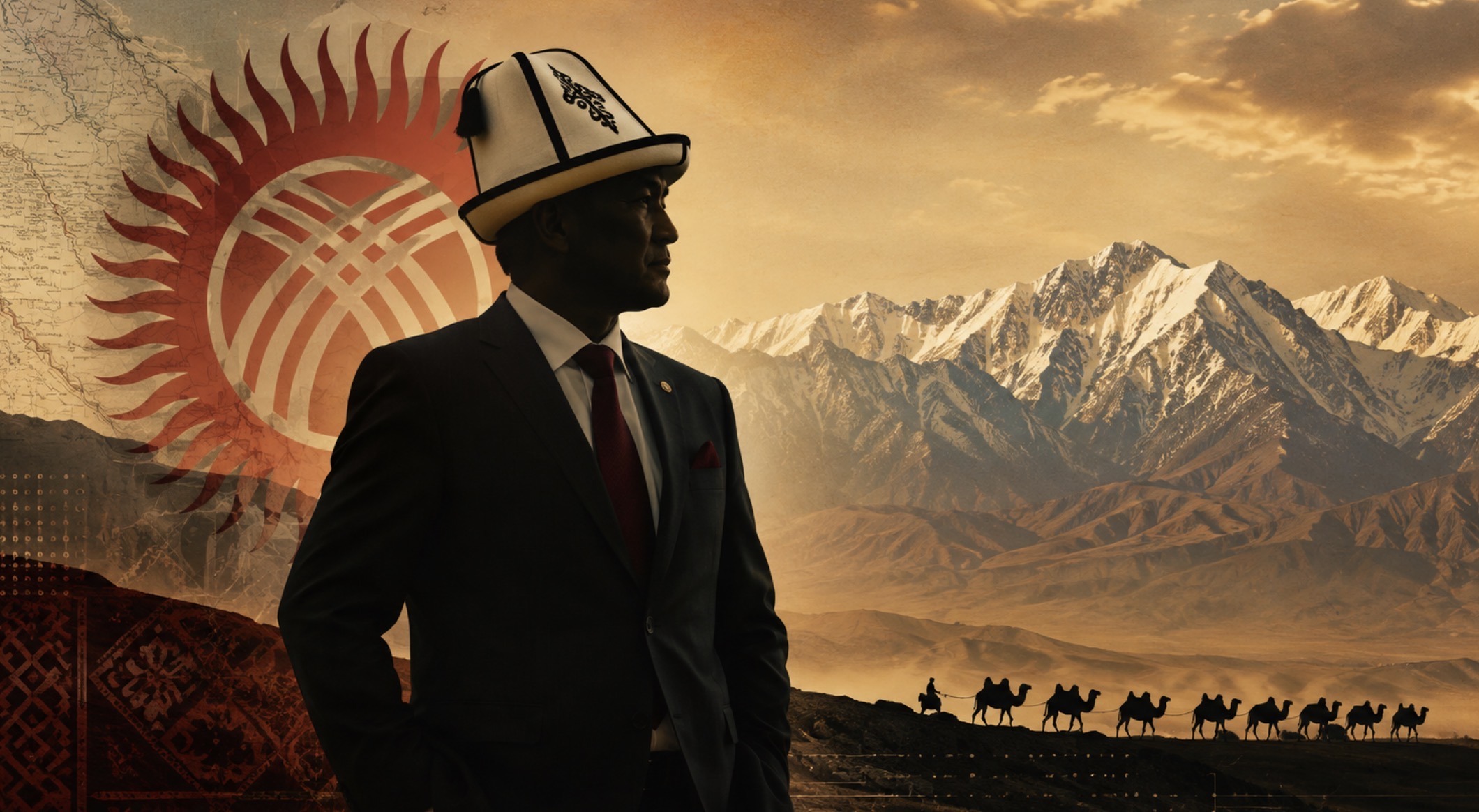
On July 3, 2026, the Pervomaysky District Court of Bishkek put a definitive end to Central Asia’s political duumvirate. Kamchybek Tashiev, the former head of the State Committee for National Security (GKNB)—a man once described much like Petro Poroshenko described Arsen Avakov in Ukraine: «not the first, but not the second either»—was found guilty of attempting a violent seizure of power in the high-profile «Letter of 75» case.
Kyrgyzstan has a notorious track record: most of its former presidents have either served prison time or been forced into exile. Even the current president, Sadyr Japarov, rose to power straight from a prison cell. It was likely there that he had a revelation: a political opponent at large is far safer than one behind bars. Consequently, he chose not to imprison Tashiev. Instead, he locked up Tashiev’s inner circle, effectively painting him as a man who betrayed his own comrades.
During the protests that ousted President Sooronbay Jeenbekov—the very unrest that freed Sadyr Japarov—former president Almazbek Atambayev was also released. Atambayev, of course, harbored his own ambitions. The sheer determination of the man can be gauged by one simple fact: during his arrest, the ex-president fired back, killing an Alpha Group officer and sending a dozen others to the hospital. At the time, he took full responsibility, insisting his bodyguards had never touched their weapons. Yet the stars (or perhaps a backroom deal) did not align in Almazbek Sharshenovich’s favor, despite his chivalrous personal traits. He was sent straight back to prison from the protests. Sadyr Japarov—released on the exact same day—became the sole leader of the protest movement, largely thanks to Kamchybek Tashiev, who firmly declared, «Sadyr Japarov is our leader.»
Soon after his inauguration, Japarov met with the former presidents in Dubai and offered them a peace pact, which they all accepted. However, the political landscape shifted dramatically on February 9, 2026, when a group of 75 prominent public figures—including ex-prime ministers, former deputies, academics, and elders (aksakals)—published an open letter addressed to Japarov. The text was polite but firm. The authors argued that the president was consolidating too much power, destroying the balance of checks and balances, and called on him to immediately announce early presidential elections.
Sensing the threat, Japarov—acting as both a former revolutionary and a shrewd Eastern ruler—moved decisively but quietly. First, in February, he unexpectedly dismissed his old comrade and «heartfelt friend,» who happened to be undergoing medical treatment in Europe at the time. He then purged the security bloc controlled by Tashiev, forcing the GKNB chief to testify against his own men. In other words, while Atambayev once took the blame to protect his bodyguards, Tashiev simply threw his people under the bus, reducing his political capital to zero. Now, Japarov has sealed Tashiev’s capitulation with a four-year prison sentence, skillfully commuted to probationary supervision. Tashiev remains free, but he has been completely defanged and stripped of ambition. The dual power is no more. The new Khan stands alone.
Cleaning the Highways: Lessons from the Early Lukashenko
Japarov’s triumph, however, would have been impossible without an earlier, more brutal maneuver: the elimination of the criminal underworld, in which his «heartfelt friend» Tashiev again played a crucial role. At the end of 2023, GKNB special forces stormed a compound and killed the top «thief-in-law» Kamchy Kolbayev, who had terrorized the country’s entire large business sector. His death decapitated the shadow mafia hierarchy that had shared power with the White House for decades.
For those familiar with the history of the post-Soviet space, this scenario feels intimately familiar. This is exactly how a young Alexander Lukashenko began his thirty-year rule in the mid-1990s. Few in the West remember that the future Belarusian Batka won absolute popularity among a population weary of chaos by ordering security services to execute—without trial or investigation—the gangster groups robbing and killing truck drivers on the forest transit routes from Brest to Minsk.
Lukashenko monopolized violence, stripping it away from the mafia, and built the foundation of his personal dictatorship upon it. Thirty years later, Sadyr Japarov has repeated this trick step-by-step on nomadic soil.
Political Geography and Eternal Knots
In the West, Central Asia is still viewed through an exotic lens, causing tectonic shifts to go unnoticed. Japarov is building an autocracy not out of personal whim, but because it is demanded by the harsh economic geography of a country that must be controlled with an iron fist:
- Mega-trade hubs: Markets like Dordoi in the north and Kara-Suu in the south operate as states within a state, channeling a colossal flow of Chinese re-exports into Russia and Kazakhstan.
- Uzbek Osh: The southern capital remains an eternal knot of ethnic and clan contradictions—a powder keg requiring round-the-clock surveillance.
- The China–Kyrgyzstan–Uzbekistan Railway (CKU): This under-construction route bypasses Russia, permanently tying the region’s transit infrastructure to Beijing.
In this geography, rulers are merely temporary caretakers. To survive between geopolitical titans, the Khan requires absolute silence at home.
The Triad of Stability and Deaf Conformism
At the top of this political landscape, now purged of both mafia and rogue security officials, three «eternal» institutions remain. All three have accepted Japarov’s new rules:
Professor Nazaraliev – the flagship of private narcology in the post-Soviet space. Many remember his aggressive advertising of sadistic drug addiction treatments, which appealed to the «New Russians» who brought their wayward children from all over the former Soviet Union. In any Western country—or even in Russia and Ukraine—he would likely have been branded a charlatan endangering patients’ health. But here, survival depends on one’s ability to maneuver, and Nazaraliev does this better than most. He has rebranded his business. The atropine comas and harsh psychological suppression methods remain, but they are no longer delivered in the brutal «teapot-to-the-face» style; instead, they are wrapped in the aesthetic of a modern recreational center with pools and comfortable cottages. He bought Japarov’s loyalty in a timely manner by officially transferring his iconic spiritual-architectural complex, Tashar-Ata, to the state. In return, his lucrative business was left untouched. The political party «Svoboda» (Freedom), which he financed, has been shut down, but his enterprise thrives.
Many might ask: am I overinflating the figure of a mere «addiction doctor»? No, I am not. Let me remind skeptics that one of the most influential people in the world, Miriam Adelson, is also a narcologist—the pioneer of the methadone treatment method. That is exactly how she met her late husband, Sheldon Adelson, who was then one of the richest men in America.
Roza Otunbayeva – the only president of Kyrgyzstan who never went to prison or fled the country. She voluntarily relinquished power. Today, Roza Isakovna serves as Bishkek’s primary diplomatic shield. Heading the UN Mission in Afghanistan, she enjoys international immunity while maintaining absolute silence regarding Japarov’s dictatorship. For her, this authoritarianism is simply the lesser evil compared to civil war.
The American University of Central Asia (AUCA) – an island of Western influence that, following the passage of the «foreign agents» law, retreated into deep internal emigration. Students here study in English, producing a new generation of Western-educated cadres. Today, they have fallen completely silent and have no plans for political protests. The resignation and conviction of the ex-head of the GKNB—the very man who backed the foreign agents law—did not push this pro-Western milieu of professionals into conflict with the authorities. Instead, they behave much like the Kyiv-Mohyla Academy crowd did under Ukrainian President Leonid Kuchma on the eve of the 1999 elections. They have begun to «tame» the president, creating an expert advisory pool around him and quietly grooming their potential Yushchenko.
The Blindness of the Intelligentsia: The Mohyla Syndrome
Inside AUCA, a young, dissatisfied, pro-Western intelligentsia is simmering. But the tragedy of these kids is that they completely fail to comprehend the chthonic energy of their own country’s masses. They are exactly like the refined intellectuals of the Kyiv-Mohyla Academy in 2013, who sincerely believed that protest was all about European values and Immanuel Kant. They failed to sense the danger emanating from the grim, smoke-scented men from the uplands near Sambir, who descended upon Kyiv and rewrote the revolution’s script to suit themselves, leaving not a trace of intellectual illusions behind.
In Kyrgyzstan, the «guys from the uplands» are the rural youth from the villages who have survived the grueling hell of labor migration in Moscow. For them, Sadyr Japarov is one of their own—an understandable leader, a «baike» (big brother) who went to prison for the people. And when a true crisis hits, they will stream into Bishkek, clear the squares, slaughter their horses, and eat them right in front of the White House, just as they did in every past coup. AUCA students are aware of this force, but they do not understand how terrifying it is, or how easily it can reduce their co-working spaces and Western grants to absolute zero.
Geopolitical Spikes on Which the Players Are Impaled
Sadyr Japarov is indeed morphing into a new Kuchma of the 1999 model. Having established himself as the sole leader, he has run headfirst into a highly complex geopolitical reality at the crossroads of four civilizations: Turkic, Chinese, post-Soviet, and Western—and, just beyond the Pamir passes, Persian as well. This reality is further complicated by the ongoing civilizational clash between the West and Iran.
Rapprochement with the West is an inevitable byproduct of his need to balance against the crushing pressure from both Moscow and Beijing—evident, for instance, in the choice of IT protocols for building a digital state. This creates an illusion of independence. An illusion, because the railway from China to Uzbekistan, financed by Chinese investment and bypassing Russia, carries far more weight than any theoretical talk of an American Hyperloop. However, that remains true only until the boys and girls graduating from AUCA systematically take control of the deep state—just as their counterparts did under the late Kuchma regime—and decide to «weave bast shoes» for the new khans.
The Cyclical Frontier
«But the first president of Kyrgyzstan, Askar Akayev, who returned to the country by agreement with Sadyr Japarov—wasn’t he the true Kyrgyz Kuchma?» the reader might object.
Yes, he was. And having completed a turbulent cycle, the country has simply returned to its logical, baseline state: a khanate squeezed between geopolitical monsters (as Viktor Yanukovych once famously put it), desperately trying to preserve at least a shred of sovereignty. Yet every time that baseline is established, a new wave of passionate activists takes to the Maidan in Bishkek to slaughter and eat a horse right on the square, thereby triggering another round of political upheaval.
This, alas, is not driven by the whims of individual politicians. It is a geographical given, inevitably turning a global crossroads into a wild frontier, and that frontier back into a crossroads. It is a reality that cannot be altered by the will of even the most desperate revolutionaries—not passionate like Lenin, but cold, monumental, and unyielding. Like Lenin Peak.