Amid the media frenzy surrounding Serbia’s recent parliamentary elections and the crushing defeat of Aleksandar Vučić’s party, the essence of what happened has been almost entirely lost. Television cameras captured the scale of the protests, but what remained outside the frame was the actual political platform of the victors: an anti-establishment student movement. Ironically, they have been informally dubbed the “Students” — which is precisely what the word “Taliban” means (in Pashto, from the Arabic talib). In Russia, this linguistic coincidence is invoked with knowing insinuations, evoking color revolutions in Western Asia and Kyiv’s Maidan. Yet the Serbian students’ manifesto differs radically from the standard pro-Western slogans.
The Serbian “Students’” platform is not about joining NATO, integrating with Brussels, or abandoning national identity. Quite the opposite: it seeks to strengthen Serbia’s pro-Russian orientation to the greatest possible extent, defend sovereignty over Kosovo, and immediately halt all covert arms supplies to Ukraine. The Students have demanded an end to Serbia’s disgraceful balancing act and backroom deals with the West, which Vučić’s regime has pursued for years behind its own people’s backs.
One might think Moscow would be celebrating this triumph. Instead, the Kremlin is gripped by panic and confusion. What frightens Russia is the very existence of an active, living society. The absurdity goes so far that the Kremlin today finds it psychologically much easier to deal with the actual Taliban, now the official rulers of Afghanistan, than with Serbian students who sincerely embrace pro-Russian positions. The Afghan Taliban is a monolithic, comprehensible hierarchical structure with which pragmatic business can be conducted. Serbian students, by contrast, represent an uncontrollable, grassroots collective agency — something the System, operating within its cynical “grey morality,” perceives as an existential threat.
The same perspective offers a way of understanding Ukraine’s long and troubled history with Moscow, where the Kremlin repeatedly committed the same fatal Hobbesian mistake.
The Mirage of 2003. The Kremlin was absolutely convinced that Ukraine’s “deep state” was entirely under its control. Industry, agriculture, banking — the entire economy was tied to relations with Russia that had been restored after the 1990s. Medvedchuk and Putin were godfathers to each other’s children, the Donetsk clans were at the height of their political power, and Ukrainian society eagerly consumed Russian culture. Yet Moscow regarded society itself not as an autonomous political actor, but as a passive mass. In cultural policy, for example, rather than promoting local cultural phenomena that belonged to the broader Russian cultural sphere, Moscow reduced cooperation to an endless parade of Russian celebrities touring Ukraine and Ukrainians in folk costumes performing in Russia.
The Trauma of 2004. The Orange Revolution was a catastrophe for the Kremlin. It appeared that Ukraine’s deep state was thoroughly permeated by Western agents and nationalist ideas. Frightened by this reality, the Kremlin did not believe Yanukovych could win in 2010 and offered no meaningful support to either him or the Donetsk clan. Instead, it placed its bets on the remnants of the old elites surrounding Medvedchuk and on the political “swamp” of Yulia Tymoshenko, with whom Putin had established a comfortable personal dialogue and toward whom a substantial share of Medvedchuk’s resources had migrated. The living Ukrainian society, which had spent the years since 2004 reassessing the Maidan’s pro-Western slogans, was once again left out of the equation. Disillusionment with Ukraine’s deep state played the decisive role.
The Blindness of 2019. When Volodymyr Zelensky emerged on the political stage, he might well have been willing to reach an accommodation with the Kremlin. But instead of offering the young president and a war-weary society an alternative political project, Moscow began vilifying him from day one. Remarkably, on the eve of the election, Vladislav Surkov publicly insisted that Petro Poroshenko was the only viable option (just as he had previously favored Tymoshenko). The System desperately needed a familiar, cynical oligarchic “lord” with whom it could strike backroom deals, rather than an unpredictable trickster backed by the street.
The same fear of genuine grassroots agency also shaped the internal tragedy of Donbas in 2014. The System systematically eliminated and discredited those who possessed authentic grassroots energy and their own deeply rooted aesthetic sense of agency and internal locus of control: Pavel Gubarev, pushed out of politics; Andrey Purgin, removed from power; and Igor Strelkov, eventually imprisoned. Their ideological convictions frightened their handlers, because a person driven by genuine beliefs cannot simply be switched off at the press of a button in some government office. In the end, they were conspicuously replaced by Denis Pushilin, a former functionary of the MMM pyramid scheme. A man without a distinct identity, without convictions, and without any instinctive aesthetic revulsion became the model of a manageable apparatchik — the ideal raw material for the “social engineering of atomization.”
But what philosophy lies behind this seemingly geopolitical stupidity? In politics, even the most absurd decision is ultimately rooted in some underlying conception of the world.
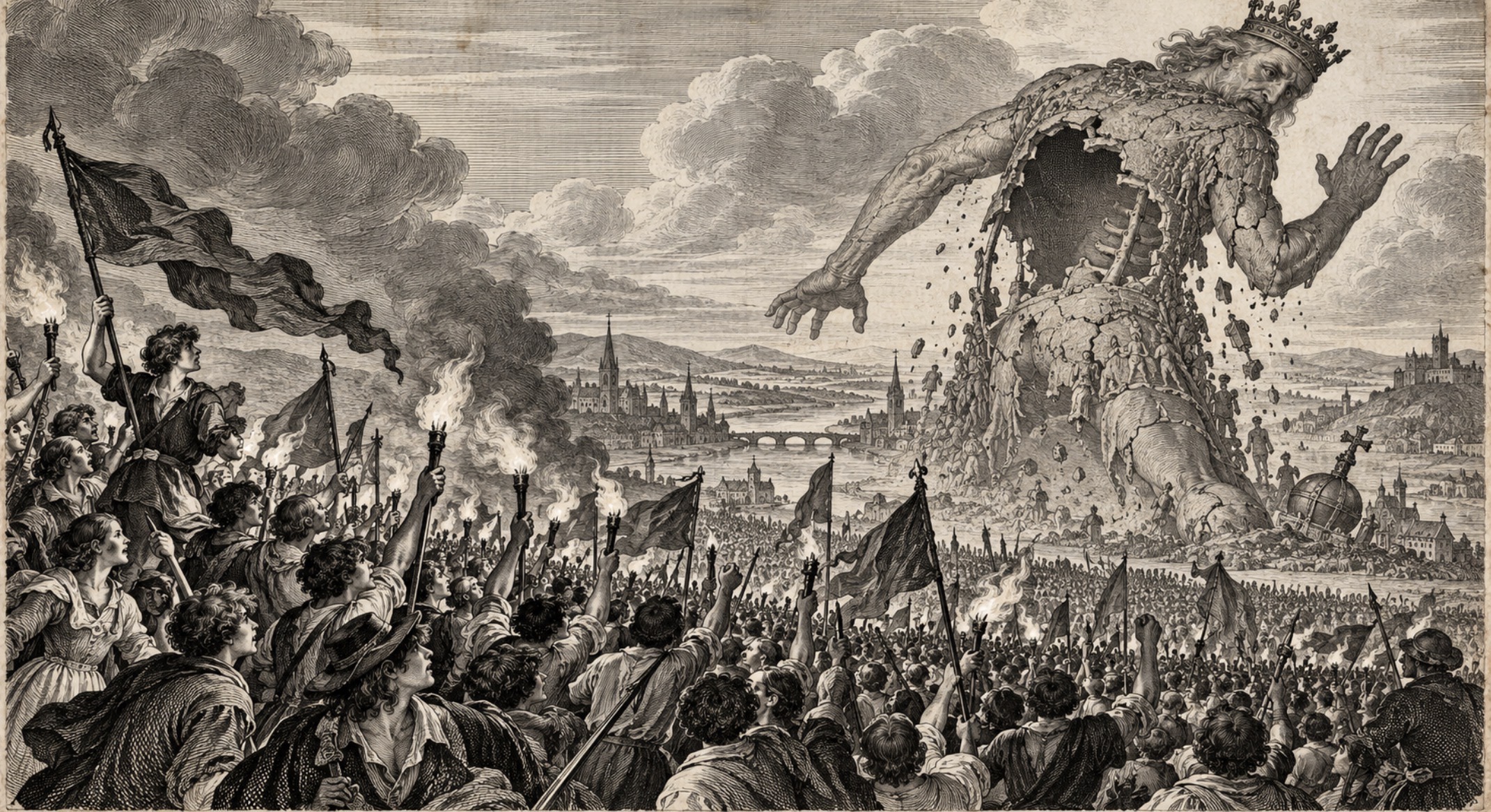
What lies behind it is a vulgar, mechanistic reading of Thomas Hobbes’s Leviathan. Hobbes, incidentally, was English — for all Russia’s ostentatious Anglophobia. Hobbes argues that humanity’s natural condition is a “war of all against all,” a state of chaos and violence that can be restrained only by an absolute, soulless monster-state: Leviathan. Within this paradigm, society as a living organism simply does not exist. There is only the supreme Sovereign (the “lords”) and an atomized, defenseless mass to be governed through fear and manufactured illusions.
The Russian elite has taken this Hobbesian construct to its digital extreme. Operating in the manner of Surkov or the IDF (it is worth recalling that the Israeli military was among the first to master information operations involving the simulation of an active society online), it learned to manufacture a fictitious, plastic society on the internet — complete with bot farms, controlled movements, and fabricated approval ratings. And it genuinely came to believe that the world is governed exclusively by backroom deals, intelligence agencies, and political PR technologies.
Yet the laws of history are inexorable: the crisis of such a Leviathan is inevitable. The history of the Enlightenment and Europe’s bourgeois post-revolutionary republics demonstrated that the mechanistic Hobbesian monster ultimately loses to a flexible, active civil society. In the seventeenth and eighteenth centuries, European elites came to understand that they had to negotiate with society and build genuine institutions of solidarity rather than merely simulate them.
The Kremlin’s digital Leviathan, devoid of trust in its own people, may, of course, defeat Ukraine on the battlefield through the sheer concentration of force and resources. But this approach leads nowhere: it will not help the regime live with such a victory, nor will it help it live without one.
In its obsession with total control, the regime systematically destroys every genuine source of its own support. First, it purges living society; then it eliminates its ideological zealots; and finally, as in Alexander Prokhanov’s Lemner, it kills even its own tame assassin.
It is no coincidence that, toward the end of the novel, the author portrays the head of state as an absolute void, manipulated by occultist women and standing on the shoulders of “three Atlases.” Prokhanov gave this figure the highly revealing name Leonid Leonidovich Troyevidov.
Having rid himself of everything tangible, autonomous, and real, Troyevidov — a kind of hologram of another Leonid, the symbol of an era of prosperity — discovers that there is no solid ground beneath his feet.
Stripped of roots, solidarity, and meaning, this Leviathan hangs suspended in midair before drifting off into the icy emptiness of history, like a brightly colored balloon filled with helium — and utterly hollow inside.