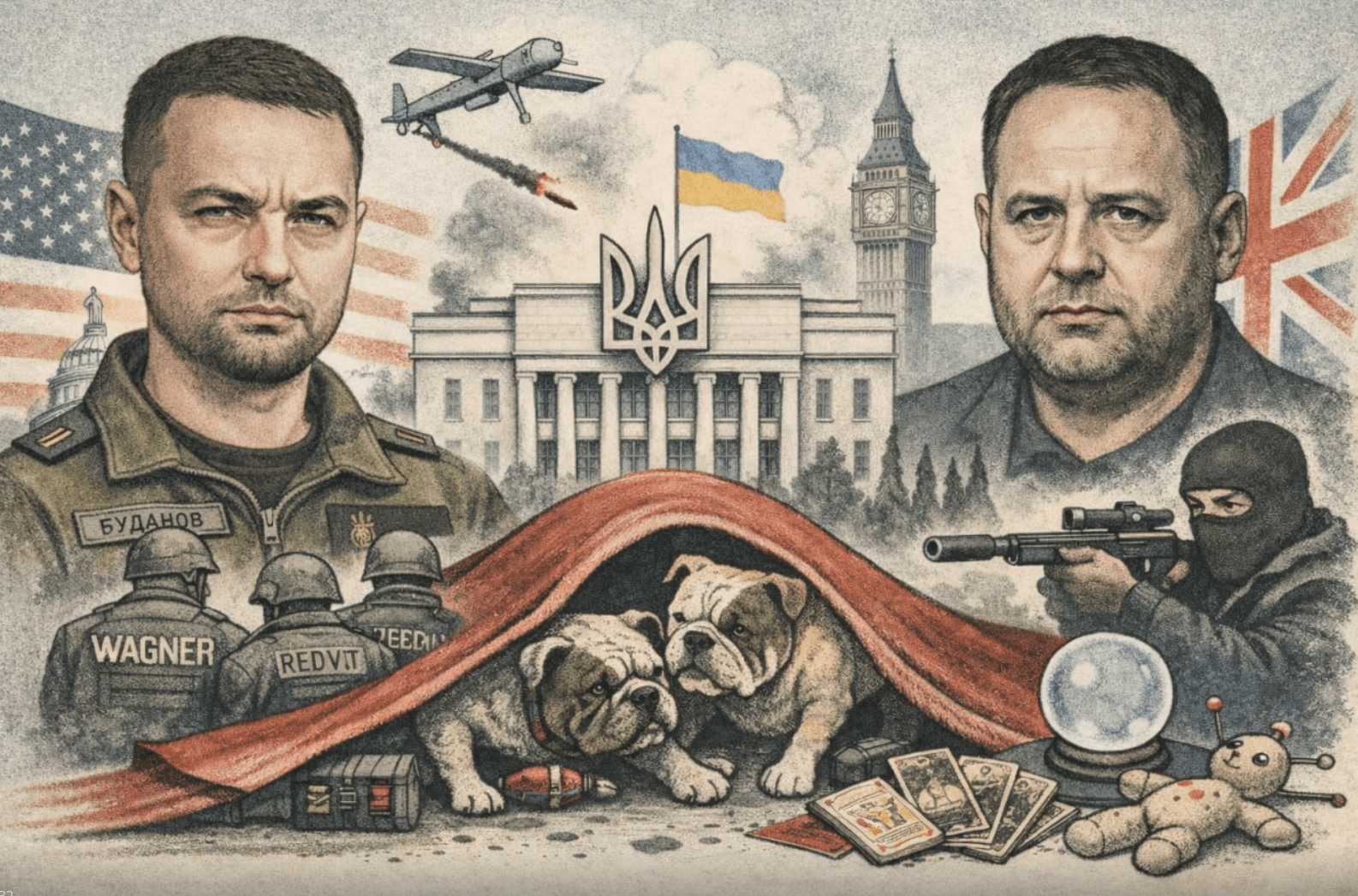
The assassination attempt on Russian military intelligence deputy commander General Vladimir Alekseev, which occurred during Ukrainian-Russian negotiations, ripped the curtain off a world most outsiders can barely imagine: behind the heroic narrative of Ukraine’s struggle for survival lies a grotesque, cartoonish reality. Kyiv presents itself to the world as a nation of epic resistance—an almost mythic battlefield where democracy fights tyranny, heroes clash with villains, and every action is elevated to historical significance.
Inside, however, the story is painfully different. Kyiv operates like a banana republic, receiving bananas from foreign sponsors as humanitarian aid, while on the domestic market, the bananas—as well as the rest of the aid—are sold for substantial sums. A caricature of governance emerges, where mystical rituals, gadget-driven power plays, and street-level kidnappings dominate daily life. Here, Yermak’s London-backed network and Budanov’s American-backed faction play a deadly, theatrical game of chess—an absurd, violent spectacle with real consequences.
Yermak may still attempt one final gambit: subjugate Budanov, turn him into a puppet, and publicly discredit him. To pull it off, he would need a masterful combination of assassinations, stargazers, tarot readers, ventriloquists, and yes, voodoo specialists. Ukrainian media has made Yermak’s fascination with mystical rituals a hot topic, feeding the sense that the theater on stage is part horror story, part fantasy.
Meanwhile, Zelensky—who once denied abuses in the TCU military recruitment system—has now ordered Defense Minister Mykhailo Fedorov to investigate systemic corruption. This is significant: structures that had long been never publicly criticized by the government, but continuously discussed on social media are now under scrutiny, signaling a direct attack on Yermak’s shadow networks. The TCU system itself is nightmarish: officers routinely kidnap civilians off the streets, often illegally, often threatening forced deployment to extract bribes. Street violence is so commonplace that reports of knife and gun confrontations appear in Ukrainian media almost every day. Outsiders liken it to ICE raids in Minneapolis—but in Ukraine, it is far worse, because every adult male is potentially vulnerable, and the ultimate beneficiaries remain Yermak’s loyalists at the top—though now exposed to pressure.
At the same time, the negotiation track has shifted to Washington, while Zelensky increasingly clashes with European leaders even as dialogue with the Trump administration improves. These moves are clear indicators of American influence rising and Budanov consolidating power, marking the slow transition from Yermak’s shadow control toward his soft sidelining.
Yet, and this is the crucial point: the transfer of initiative from the EU to the U.S. does not guarantee a peace agreement. By pushing the EU out of mediation, Washington has already achieved its strategic goals. The halt of the conflict itself is not primarily in the hands of governments—it is in the interest of the Ukrainian and Russian peoples.
To the public, Ukraine fights a heroic, almost cinematic battle—Na’vi-like defenders of Pandora or Fremen warriors on Arrakis—but in reality, the streets are ruled by corruption, kidnapping, and grotesque bureaucratic theater. The contrast is jarring: heroism as PR, chaos as reality.
The transition from Yermak to Budanov is not fantasy. London’s influence wanes, Washington’s power grows. Negotiations move to Washington, Oleg Ivashko takes control of the GUR, Fedorov’s office is tied to USAID, and billions in American funding flow under direct supervision. Experts say Budanov will need six months to “reprogram” the system, with provocations, sabotage, and disruption inevitable along the way.
And yes, the United States wants peace—but its priority is influence, not immediate reconciliation. Peace is desirable, particularly for Ukrainians and Russians, but in Kyiv, the real game is control. The world sees a heroic struggle; insiders see a grim, absurd, violent puppet theater, where gadgets, occult rituals, kidnappings, and global power plays collide. Welcome to Kyiv.