Special Analytical Report
The closing days of August have brought a succession of tectonic shifts to the international security architecture—developments that military analysts are increasingly classifying as «pre-war symptoms.» The pieces on the geopolitical chessboard are now fully deployed, and the most vulnerable friction point, primed to detonate at any moment, is Russia’s Kaliningrad enclave.
Prelude to the Storm: Markers of the Past Week
- Polish Tanks on the Russian Border: Warsaw has begun deploying its newly acquired, state-of-the-art South Korean K2 Black Panther main battle tanks to the 16th Pomeranian Mechanized Division. Units of this division are stationed just a few kilometers from the borders of Russia’s Kaliningrad Oblast.
- Emergency Intelligence Diplomacy: CIA Director John Ratcliffe made an unannounced visit to Moscow for a high-stakes, closed-door meeting with FSB Chief Alexander Bortnikov. The last time a CIA director made such a clandestine trip to Russia—then William Burns—it occurred on the absolute eve of the Russian invasion of Ukraine. Many intelligence experts believe Ratcliffe’s mission this time was to directly warn the Kremlin against launching hybrid attacks targeting the Baltic states. While the precise details remain classified, the rationale behind these assumptions is clear: Moscow has grown increasingly explicit in its direct military threats against Ukraine’s allies, with the Baltic nations occupying the frontline of this friction.
- The Vatican Mobilizes Diplomatic Channels: Almost simultaneously, Archbishop Paul Gallagher, the Vatican’s Foreign Minister, arrived in Moscow. The Holy See is activating extraordinary diplomatic tracks, issuing a stark warning that «the world needs diplomacy now more than ever» at a time when strategic trust has completely evaporated.
- Integrating Ukrainian Combat Experience into NATO: On August 28, 2026, Ukraine’s former Minister of Defense, Mykhailo Fedorov, was officially appointed as an advisor to the Italian Minister of Defense on military innovation and the «technologies of modern warfare.» This appointment signals a rapid, systemic scaling of drone warfare expertise across both the southern and eastern flanks of NATO.
- An Ultimatum from the Kurils: Vladimir Putin made a highly symbolic trip to the Kuril Islands, using the platform to vow a symmetrical and asymmetrical response to the European seizure of Russian «shadow fleet» vessels, which he branded as «pure piracy.» This escalating tension has already spilled over into physical reality: armed border patrol units equipped with machine guns have been spotted aboard Russian commercial tankers navigating the Baltic Sea.
To compound these friction points, one must factor in Moscow’s direct threats leveled against London, Latvia’s newly enacted deportation laws targeting local ethnic Russians who hold Russian Federation passports instead of Latvian citizenship, and the strategic positioning of Sviatlana Tsikhanouskaya’s opposition office in Vilnius.
Furthermore, the situation in Estonia’s Narva and Kohtla-Järve regions—where over 90 percent of the population is ethnically Russian—presents a volatile flashpoint. In Estonia, this manifests as an aggressive social media campaign pushing for the creation of a «Narva People’s Republic,» alongside direct territorial incursions. In December 2025, armed Russian border guards on an amphibious craft landed on an Estonian breakwater near Vasknarva, staging a deliberate 20-minute standoff captured entirely on surveillance cameras. Adding to this, since the winter of 2026, Russian electronic warfare (EW) complexes have blanketed the Narva region, completely jamming GPS signals. This tech blockade forces civilian vessels and small boats to navigate blind, carrying the perpetual risk of straying into Russian waters and triggering an international hostage crisis.
Should a hot crisis erupt between the Russian Federation and NATO in the Baltic theater, its epicenter will inevitably be Russia’s Kaliningrad enclave—a territory that finds itself de facto trapped. From that moment on, the geopolitical moves will unfold with the predictability of a classic chess opening: a NATO attempt to enforce a naval blockade in retaliation for Moscow’s «machine-gun diplomacy» will completely cut off the enclave. This will leave the Kremlin with no choice but to launch a conventional military breakthrough across the Suwalki Gap. If that threshold is crossed, the Baltic Sea will close entirely, triggering a rapid, multi-stage escalation:
The Four Steps of Escalation
STEP 1: The «Black Holes» Go on the Hunt
The conflict will inevitably begin beneath the surface. Realizing the impossibility of an open surface engagement with NATO naval forces—a reality starkly proven by recent combat experiences in the Black Sea—the Russian Baltic Fleet will bet entirely on stealth. Upgraded Project 636.3 Varshavyanka-class diesel-electric submarines (dubbed «Black Holes» by the West for their extreme acoustic quietness) will slip into the depths. Their objective: torpedo strikes and Kalibr cruise missile launches targeting both Alliance warships and commercial vessels.
The Outcome: The instantaneous paralysis of merchant shipping across the entire Baltic region. Leading global maritime syndicates, including Lloyd’s, will immediately cancel insurance coverage for any vessel entering the area, effectively sealing the Baltic Sea commercially.
STEP 2: The «Baltic Trap» (Total Naval Mining)
Commercial paralysis will swiftly give way to physical blockade. In an effort to secure their respective coastlines and trap adversarial forces, both sides will resort to the chaotic, large-scale deployment of thousands of bottom and moored naval mines. Expansive minefields will choke off the region’s vital maritime arteries: the Danish Straits, as well as the exits from the Gulf of Bothnia and the Gulf of Finland. Compounded by harsh autumn and winter storms, moored mines will inevitably break free from their tethers.
The Outcome: The sea transforms into a «gray zone» of absolute danger. Search-and-rescue operations become functionally impossible, and traditional navigational charts lose all validity.
STEP 3: Black Water and Dead Airwaves
The catastrophe assumes physical form. The initial casualties will be the tankers of the Russian «shadow fleet» and European bulk carriers. Torpedo impacts will breach hulls, converting millions of barrels of crude oil into massive, spreading slicks. In the cold, brackish waters of the Baltic, petroleum products degrade at an exceptionally slow rate. Simultaneously, a covert war of sabotage will unfold on the seabed. Specialized underwater units will systematically destroy submerged infrastructure, severing the transatlantic fiber-optic cables that link Scandinavia to the continent, as well as critical mainline gas pipelines.
The Outcome: A global digital blackout and a severe energy crisis across Northern Europe, transpiring against a backdrop of total ecological collapse.
STEP 4: Ecocide. Unsealing the Chemical Weapon Dumps
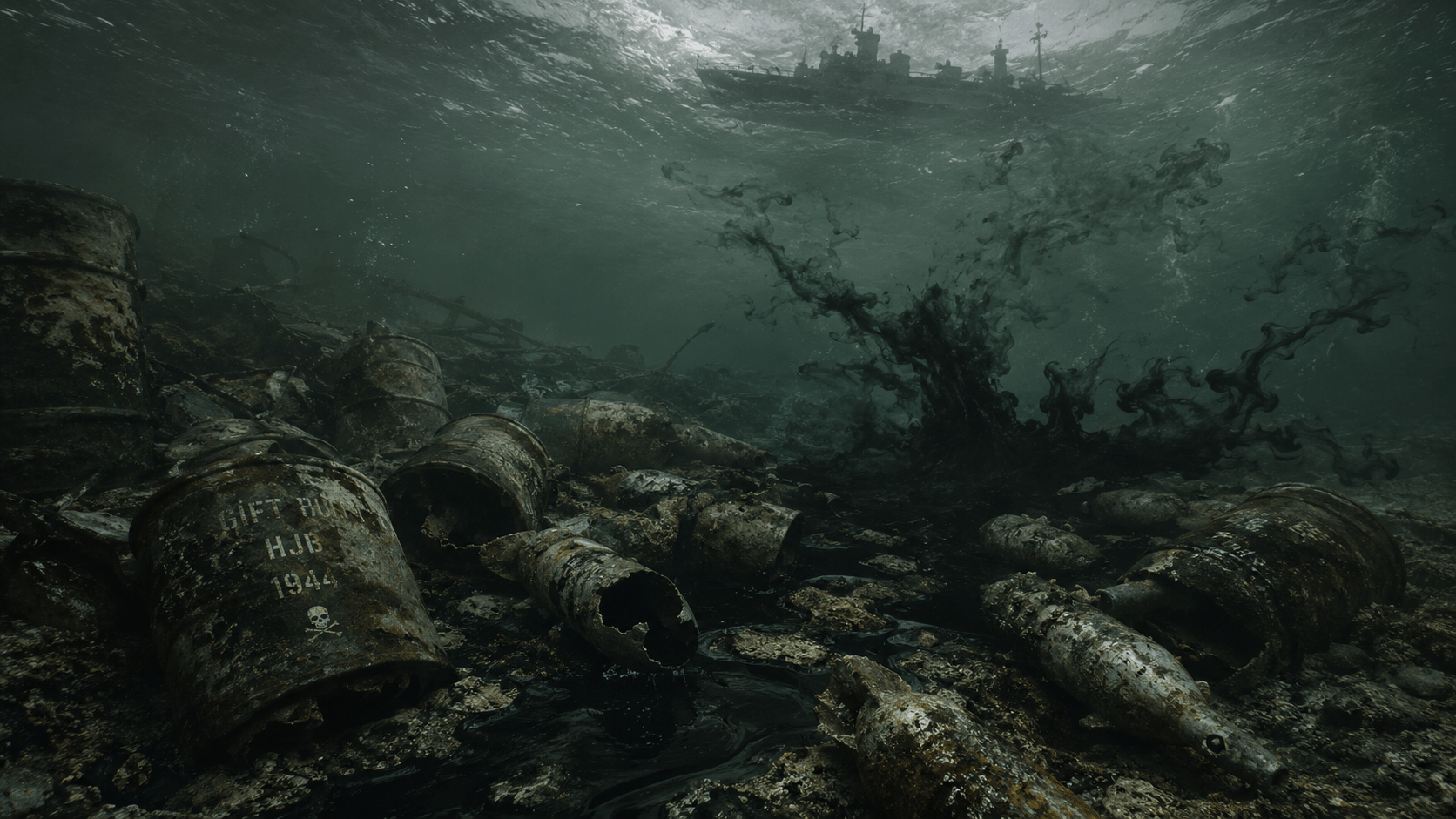
The final movement of the scenario. To detect and eliminate Russia’s silent submarines, NATO anti-submarine warfare (ASW) assets will launch a massive hunt utilizing deep-water torpedoes and high-yield depth charges. These kinetic strikes will detonate precisely within the deepest marine trenches—the Bornholm and Gotland basins—where the submarines will attempt to seek refuge. The catastrophic complication is that these exact depressions serve as the final resting place for 300,000 tons of captured Third Reich chemical munitions. Powerful hydrodynamic shockwaves will shatter the casings of German aerial bombs and storage containers, heavily corroded by eighty years on the seafloor.
The Outcome: Tons of mustard gas (yperite), sarin, and phosgene will rise from the abyss. Liquid mustard gas will turn the benthic waters into a toxic wasteland, obliterating the entire marine ecosystem, while volatile gaseous fractions are carried by storm winds toward the coastline. Inhabitants of coastal megacities will face an immediate threat of mass chemical poisoning.
The Lesson of the Black Sea: The Illusion of the Impossible
To those who still dismiss this apocalyptic scenario as academic scaremongering or excessive hyperbole, it is time to look back. Look at the Black Sea. Could anyone five years ago have truly believed that the premier resort region of the former Soviet Union would transform into a closed, lethal combat zone?
Today, the Black Sea is functionally dead to legitimate global shipping. Its waters are littered with hundreds of drifted naval mines that storms routinely wash onto the beaches of Romania, Bulgaria, and Turkey. The seabed is choked with the wreckage of cruisers and amphibious assault ships oozing heavy fuel oil. The coastline has witnessed the mass die-off of dolphins, their internal organs ruptured by military sonar systems, while the destruction of the Kakhovka Dam dealt the region a shattering toxic blow. For decades to come, the Black Sea has been reduced to a gray zone of localized ecocide and a logistical dead end.
Yet, the Baltic will not merely repeat the fate of the Black Sea. It will become a manifold, vastly more terrifying escalation of it.
While nature in the Black Sea can partially cope due to its immense depths and its connection to the Mediterranean via the Bosphorus, the Baltic is a shallow, landlocked «appendix» with catastrophically slow water circulation. A complete exchange of its water takes thirty years. Any large-scale oil spill or surge of toxins will remain locked inside indefinitely. The Baltic simply lacks the biological capacity to digest a war waged by technological giants. The unsealing of the Bornholm and Gotland chemical weapon graveyards will leave coastal ecosystems absolutely no chance of survival. It will mean the instantaneous death of an entire sea.
A Name as a Sentence: Königsberg, Królewiec, Kaliningrad
A dark historical irony permeates this tragedy. The situation surrounding Kaliningrad painfully echoes the famous motif of the old jazz standard, «Istanbul (Not Constantinople).» Yet, while in the song Constantinople became Istanbul at the absolute zenith of imperial majesty and the triumph of conquerors, on the shores of the Baltic, this process threatens to unfold in reverse—through total geopolitical collapse.
Today, this pocket of land is called Kaliningrad in Moscow, but Warsaw officially renamed it Królewiec back in 2023, and the historical name Königsberg resonates with increasing clarity in Vilnius and Berlin. Should the war enter a hot phase, Kaliningrad will cease to be Kaliningrad. However, its return to its roots will not be the product of peaceful diplomacy; instead, it will come by way of demilitarization, occupation, and international administration. Königsberg will reappear on geographical maps as a tombstone to a vanished empire.
It is highly symbolic that Istanbul itself, which lent its name to this historical metaphor, is rapidly losing its former monolith. Against the backdrop of a tectonic schism between East and West, analysts are increasingly discussing the physical and mental partitioning of the Turkish megacity into European and Asian halves, controlled by diverging geopolitical forces. The world is entering an era where centuries-old statuses-quo and inviolable borders crumble into dust.
The Collapse of Civilization and the End of the Eurocentric Era
The repercussions of this maritime collapse will refuse to be contained within the limits of the Baltic coastline. Instead, they will deal a lethal blow to global civilization and the international economy.
The Baltic trade corridor is one of the primary jugular veins of global commerce. Immense flows of hydrocarbons, foodstuffs, metals, and fertilizers transit through the Danish Straits. The paralysis of this chokepoint, coupled with the systemic destruction of submerged transatlantic communications cables, will collapse global financial markets within hours. In Northern Europe, the twin forces of a digital blackout and acute energy starvation will instantaneously trigger a manufacturing depression of planetary proportions. The resulting systemic failure will completely dismantle the long-established supply chains that bind Asia to the Americas.
The mutual brinkmanship of the opposing sides, their stubborn refusal to seek compromises, and their reckless muscle-flexing across the narrow geographic confines of the European North are steadily dragging humanity toward a historic abyss. This geopolitical game of chicken will culminate in a catastrophe that permanently shutters the centuries-old era of European dominance in world history. Amid the smoldering ruins of this conflict, there will be no victors. The sheer scale of the ecological, radiological, and chemical devastation will leave the European continent entirely uninhabitable for civilized life. In this conflagration, both Russia and Europe will burn simultaneously and irretrievably, reduced to lifeless monuments of their own fatal hubris.
📰 SIDEBAR: «Machine-Gun Diplomacy» in the English Channel
«We see you. We know what you are doing.»
— From an official statement by the UK Ministry of Defence.
A stark illustration of this scenario taking flesh is unfolding before our eyes. On August 29, the British defense establishment reported an emergency 72-hour operation in the English Channel. Three Royal Navy warships and anti-submarine aircraft spent three days escorting a Russian military group.
The context of this transit is unprecedented: the Russian large anti-submarine ship Admiral Levchenko and the frigate Neustrashimy were acting as a direct combat escort for two sanctioned cargo vessels (the bulk carriers Sparta and General Skobelev).
What once seemed like a routine transit has mutated into a raw show of force. Moscow no longer relies on maritime law. Responding to London’s threats to seize vessels belonging to the «shadow fleet,» the Kremlin has begun deploying frontline warships to «shepherd» commercial cargoes through the territorial waters of NATO countries. The British fleet, its resources currently stretched thin across the globe, limited itself to logging the movement and maintaining a silent 72-hour escort.
This is the opening gambit of our scenario. The shadow fleet has received an official military bodyguard right off the coast of Great Britain. The next stop is the Baltic Straits. And there, the response will no longer be limited to «mere observation.»